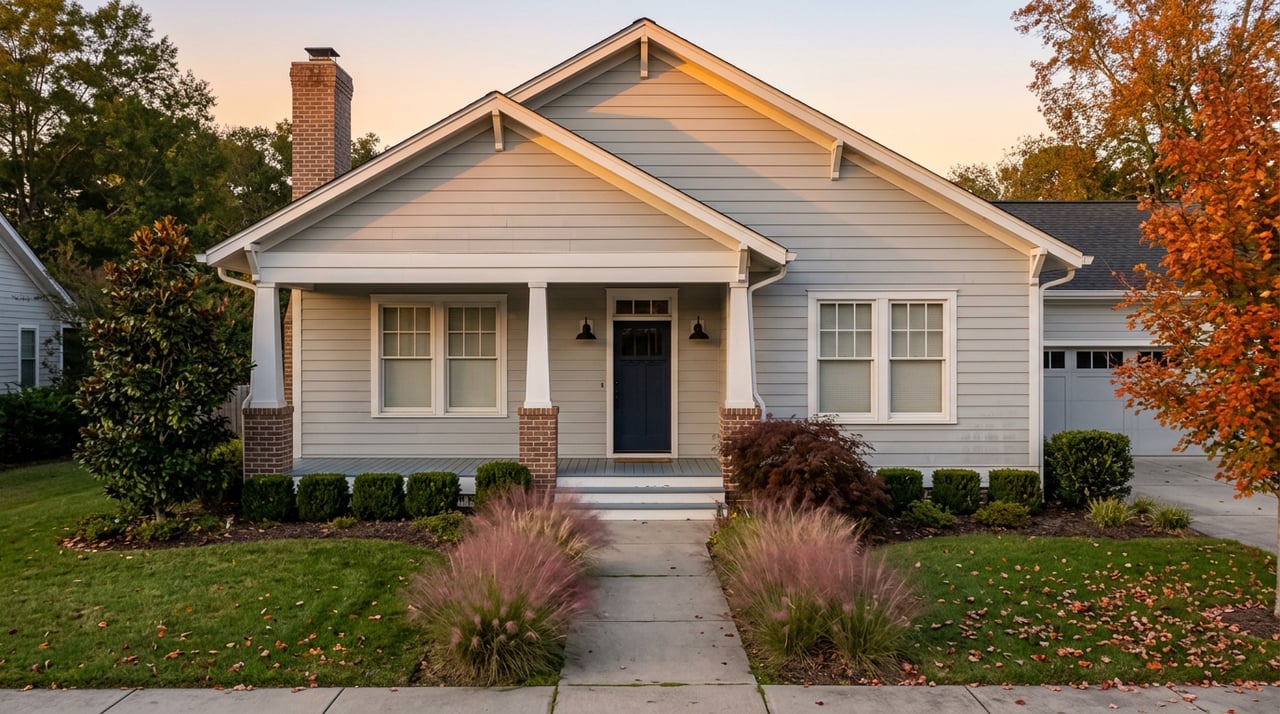
If you have been watching Apex on the portals, you have seen a market that looks like it is cooling. Median sale prices are lower than a year ago. Homes are sitting longer. More than half of the active listings have taken a price cut. If that were the whole story, the read would be simple: buyers wait, sellers concede.
It is not the whole story. Two miles south of downtown Apex, cranes are up on a 1,100-acre master plan, a $7 billion New York developer has broken ground on its first apartment buildings, and a UNC-Duke children's hospital is drawing a 230-acre outline at the intersection of US-1 and NC-540. The portal numbers and the institutional numbers are pointing in opposite directions, and that gap is where the actual buying and selling decisions get made in Apex right now.
What the portals actually say, and what they leave out
The headline stats are real. In the three months ending May 2026, the median Apex sale price was $617,000, down 1.7% year over year, with homes taking 35 days to sell versus 19 days a year earlier. June 2026 figures from Houzeo put the median at $630,000 with 54.5 days on market and 58.56% of listings taking a price reduction, up from 51.54% a year prior. Movoto's July 2026 snapshot has the list-side median at $639,000 with 61 days on market.
Two numbers complicate the cooling narrative. Supply sits at 1.07 months. And the sale-to-list ratio is 98.67%.
A market with barely one month of inventory is not oversupplied. A market where accepted offers still come in at more than 98% of ask is not one where sellers are capitulating. What has actually happened is that a specific type of listing, the one priced from last year's memory, is now getting corrected before it sells, and everything else is moving close to ask in a normal amount of time. The average sale price captured by Kairos Properties from Doorify MLS for the June 12 to July 12, 2026 window was $682,308, up 2.5% from the prior month, which is not the shape of a market in retreat.
The thesis of this post: the softer surface numbers reflect price discipline catching up with sellers, not weakening demand. Underneath, the demand side is being reinforced by a chain of infrastructure and institutional commitments that will take a decade to fully arrive but are already shaping who is buying where.
The catalyst stack, in the order it landed
The sequence matters more than any single item.
- September 25, 2024. Complete 540 Phase 1 opened, extending the Triangle Expressway 18 miles from the NC-55 Bypass in Apex to the I-40/I-42 interchange in Garner, with a diverging diamond interchange at Holly Springs Road. Southwestern Wake County stopped being the far corner of the Triangle.
- July 10, 2025. NC Children's, a partnership between UNC Health and Duke Health, announced Apex as the site of the only freestanding, independent children's hospital in the Carolinas, on roughly 230 acres at US-1 and NC-540. When complete, the campus is projected to bring about 8,000 jobs, a 500-bed hospital, and 103 behavioral health beds. Groundbreaking is expected in 2027, opening in the early 2030s.
- August 2025. The Wake Tech Board of Trustees approved the master plan for the Conlon Western Wake Campus, a 34-acre, roughly 3,000-student campus oriented around life sciences and healthcare, with construction expected to begin around late 2026.
- October 2025. RXR broke ground on Summit House, Veridea's first apartment complex, with two luxury buildings and an opening projected for early 2028.
- April 2026. The next phase of Veridea infrastructure and vertical construction moved forward, with Lennar actively selling Phase 1 residential across 319 single-family detached homes, 643 townhomes, and 148 condominiums, floor plans from 1,544 to 3,152 square feet, starting from the low $400s.
You do not often see two academic medical systems that compete for talent and donors, UNC and Duke, agree to build together on the same 230 acres. When they do, it is a bet on the location's trajectory that is worth reading closely.
What the mid-$600s actually buys in Apex right now
The town median is a blended number. The submarkets underneath it are not moving together. Here is how the mid-$600s reads across three different parts of Apex in summer 2026, based on active MLS activity and new-home pricing from Lennar's Veridea sales.
| Submarket | What roughly $600K–$650K tends to buy | What is moving the price |
|---|---|---|
| Established east Apex (Preston, Haddon Hall, Shepherds Vineyard) | 2,600 to 3,400 sq ft resale on larger mature lots, updated but not new, established landscaping | Longer days on market and more room to negotiate on homes that have been listed 45+ days |
| New construction corridor (Sweetwater, Bella Casa, Scotts Mill) | 2,200 to 2,900 sq ft newer builds, smaller lots, builder incentives on rate buydowns | New construction accounted for about 32% of Apex transactions, giving buyers a real alternative to resale |
| Southwestern 540/Veridea corridor (Lennar at Veridea) | Townhomes and smaller detached plans from the low $400s, larger detached plans stretching into the mid-$600s | Pre-anchor pricing before the hospital, Wake Tech, and Veridea Place retail arrive |
The buyer who reads only the town-wide median is missing the fact that the same dollar amount buys three different bets: a mature neighborhood at a discount, a builder incentive package, or an early position in a district that will look very different in ten years.
The transaction friction most out-of-market buyers miss
If you are coming from a metro where a 1-month supply market means bidding wars and waived inspections, Apex in 2026 will feel like it should behave the same way. It does not, quite.
- Price cuts are not distress. With 58.56% of listings taking a reduction in June 2026 versus 51.54% a year earlier, a price cut is now the norm on any home that launched above the comps. Do not read a reduction as a wounded seller. Read it as a seller who now understands the market they are actually in.
- Days on market is bimodal. The median is around 54 to 61 days, but well-priced homes in desirable pockets still go under contract in the first two weekends. The average is stretched by the tail of overpriced listings. If a home sits past 30 days in Apex right now, it is almost always a pricing problem, not a property problem.
- Sale-to-list stays high. At 98.67%, the room to write a "market softening" offer at 92 or 93 cents on the dollar is narrower than the days-on-market data suggests. The negotiation is happening on the list price itself before the offer, not on the accepted price after it.
- Builder incentives are the real lever right now. With new construction at roughly 32% of transactions, resale sellers are quietly competing with builder rate buydowns and closing-cost contributions that do not show up in any median. A resale asking $640,000 is often up against a builder offering an effective payment on a $660,000 new build.
- The 540 toll changes commute math case by case. For buyers headed to RTP or east Wake, Complete 540 Phase 1 shortened the trip meaningfully, but the toll adds up over a year of daily use. It is worth pricing before choosing a submarket, not after.
Who should be moving now and who can wait
For a move-up family looking at established east Apex, the current window is a genuine opening. You are negotiating against sellers whose comps are last year's peak and whose listing has been out long enough to make the price feel real. This is where the softer surface numbers translate into actual leverage.
For a relocator with any expected tie to the NC Children's ecosystem, whether clinical, research, life sciences, or the supply chain that follows a hospital of this scale, the southwestern corridor deserves a serious look while it is still a pre-anchor market. Groundbreaking on the hospital in 2027 is the moment when the neighborhood story stops being speculative and starts being priced in.
For a downsizer already in Apex, the current market is friendlier than the days-on-market number implies, provided the list price is set to July 2026 comps rather than 2023 memory. Homes that launch correctly are still moving inside a month at close to ask. Homes that launch aspirationally are the ones stretching the town-wide average.
FAQ
Is Apex a buyer's market or a seller's market right now? Neither cleanly. With 1.07 months of supply and a 98.67% sale-to-list ratio in June 2026, sellers still hold structural leverage. With 54 to 61 median days on market and a majority of listings taking price cuts, buyers have real room to negotiate on anything that has been sitting. It is a market that rewards accurate pricing on both sides.
Should I wait for the Complete 540 loop to finish before buying? Phase 2 is scheduled for completion in 2028, extending the expressway another 10 miles from I-40 to the I-540/I-87 interchange in Knightdale. Waiting for the full loop is waiting through the arrival of Veridea's first residents, the Wake Tech campus construction, and the NC Children's groundbreaking. Prices in the southwestern corridor are more likely to reflect those milestones than to wait for the ribbon cutting.
Does the NC Children's announcement mean prices will spike? Not immediately, and not evenly. The hospital opens in the early 2030s. What tends to move first is proximity to the construction site and the workforce housing that clusters around institutional employers. Apex-wide medians will feel a slower, broader lift, if the pattern from other Triangle anchor announcements holds.
How does Apex compare to Cary or Holly Springs on price right now? Apex's June 2026 median sits in the same band as Cary and above Holly Springs on a price-per-square-foot basis, with faster historical turnover. The Apex-versus-Cary and Holly Springs comparisons are worth a separate side-by-side, which you can find in the neighborhood guides on our site.
If you are trying to place a specific street, floor plan, or timeline against the numbers above, that is the conversation worth having in person. At Home with Jody works with buyers and sellers across Apex and the greater Triangle every week, and the story any single street tells is often sharper than the town-wide median. Let's talk about your next move.